Thursday, 6 June 2013

Indonesian Cinema and the Rise of the New Noir - The Gaurdian

Indonesian cinema and the rise of a new noir

Film-makers in Indonesia are harnessing Hollywood's dark arts to ask questions about their own society
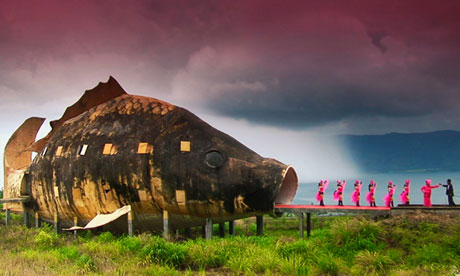
The Act of Killing (2012)
Fine new form … a film still from Joshua Oppenheimer's The Act of Killing (2012)
But even more than the grand conspiracies, it's personal territory that holds the greatest promise for Indonesian noir. The genre was always at its most successful when it touched on the frailty and temptation inside everyone. The American films were populated by weary molls and petty insurance scamsters, inept adulterers and ordinary Joes with a past – everyday folk taking short cuts and inevitably paying the piper.
And it's just those sorts of insecurities that, as he stages his past misdemeanours in The Act of Killing, catch up with Anwar Congo. There's a moment when the muezzin outside interrupts the murderous mood that he and his fellow actors are cooking up for their opening scene, and they wait to resume filming. Their kitsch is suddenly electrified by something profound; it's like God, the voice of judgment lilting down, is teaching them noir's true depths. Congo is irritated, and rants about his disdain for human rights. But something is happening to him. Later, playing a communist himself in another menacing interrogation, he seems to break down, and a redemption of sorts begins.
It's clear that the conscience of the killer has been caught through envisioning and staging these tacky scenes. The one-time king of the noir underworld is now caught in the whirlpool. Oppenheimer has managed to pinpoint a moment where cinema and the real world touch, and create heat. The question of representation, and what it can achieve, doesn't look so dumb after all.
• The Terracotta film festival starts tomorrow. Belenggu screens as part of its horror all-nighter on Friday. Details: terracottafestival.com. The Act of Killing is out on 28 June.

Inter-titles

Kath Bowden
Media Room
Friday 7th of June
Brainstorming Session


At the moment I have been researching some changes in my script for my Film Noir Film
I would really like to cut out as much dialogue as possible to avoid boredom and use inter titles. I first came across this in the start of the film Thoroughly Modern Millie.


Wikipedia says >>

Intertitle


From Wikipedia, the free encyclopedia
Intertitle in The Birth of a Nation (1915)
In motion pictures, an intertitle (also known as a title card) is a piece of filmed, printed text edited into the midst of (i.e. inter-) the photographed action at various points, generally to convey character dialogue ("dialogue intertitles"), or descriptive narrative material related to, but not necessarily covered by, the material photographed ("expository intertitles").[1]
Intertitles, then known simply as "titles", were a mainstay of silent films once the films became of sufficient length and detail to necessitate dialogue and/or narration to make sense of the enacted or documented events. The earliest known use of intertitles was in the 1901 British film Scrooge, or, Marley's Ghost.[2] The first Academy Award presentation in 1929 included an award for "Best Title Writing," but the award was never given again, as intertitles went out of common use due to the introduction of "talkies".[3]
In modern film, intertitles are used to supply an epigraph, such as a poem, or to distinguish various "acts" of a film or multimedia production by use as a title card. However, they are most commonly used as part of a historical drama's epilogue to explain what happened to the depicted characters and events after the conclusion of the story proper.
The development of the soundtrack slowly eliminated their utility as a narrative device (they were common for providing narration, but not dialogue, well into the 1930s), but they are occasionally still used as an artistic device. For instance, intertitles were used as a gimmick in Frasier. The BBC's drama Threads uses them to give location, date and information on distant events beyond Sheffield. Law & Order use them to give only the location of the upcoming scene. Guy Maddin is a modern filmmaker known for recreating the style of older films, and uses intertitles appropriately. Some locally produced shows, such as quiz bowl game shows, use animated variations of intertitles to introduce the next round.
"Intertitle" is an academic term invented long after the advent of sound film (see also subtitle (captioning) and supertitle).[citation needed] These "titles" should not be confused with the modern-day definition of subtitle or main title.
Example of an Inter-title Silde
Modern/ Contemporary Uses Include - The Artist (2011) a black and white silent comedy drama, the writer of the screen play struggled to make the story comprehensible, without using to many inter titles, apparently research was very important.

My thoughts - I think that I will change around with the dialogue on my script and see if making it a silent film with inter-titles or just with minamalist dialogue and a combination of inter titles or not.


Update: Discussion with teacher - I have decided not to plan my inter titles and I must be careful as they are often associated with comedy, and also I must adhere to a certain amount of conventions to create a 100% stereotypical Film Noir film.

Thursday, 9 May 2013

Film Concept


CONCEPT:

Target Audience: The concept for my four to eight minute film noir short film will be targeted at a wide audience but mainly an older audience accustomed to film noir unlike the younger generation who enjoy the newer neo noir.

Title: The film will be called “The Smoke” a foreshadowing title that alludes to glamour and mystery.

Conventions Included (5):

Plot Synopsis- A detective’s (Compton Ward) mobster brother (Dixon Ward) comes to him and tells him of a new drug on the street that has been worrying the underground of the city code name run by a mysterious crew named The Smoke. Meanwhile the detective’s innocent girlfriend (Evie/ Evangeline) works at a speak easy bar and one day goes missing – the detective runs to the bar that is completely trashed with a single cigarette sitting on the bar. The two brothers team up to find out what happened to Evie. Together they shake down criminals in a montage sequence- every time the audience will catch a glimpse of a mysterious figure watching them in back leather gloves. They confront the man beating a confession out of him until he tells them about a drug drop that the mysterious leader of the smoke will be at. They are situated in an abandoned theatre -going to find this mysterious criminal figure- then they find out that he is been Evie all along who faked her own death! The film ends as the brothers engage in a huge shoot out with the femme fatale and her henchmen. A stray bullet catches the femme fatal and as she is dying but whispering that she always loved him.

Characters and Motivations:
·      Detective Compton Ward – Wants to capture the mysterious smoke gang and find out what happened to his girl.
·      Dixon Ward – The Mobster – Wants to help his brother and take back control of the underworld
·      Evie/ Evangeline – The Innocent waitress/ Femme Fatale – wants to maintain control of the underworld, having to make a choice between love and money
·      Bruno – The Henchman- wants to serve his master and to kill the ward brothers
·      Group of Henchmen 3-4 – Shoot the good guys
·      Speak easy bar patrons 3-4- Drink and mind there own business.

Practicalities:

Settings-  Settings will have to be quite basic as some students are boarders so as many on school shots as possible – and as it will be shot in Black and White this will add a dark tone. Rain is important as well as damp streets add to the mise-en-scene, Kings college stairway shots, Window shots, Staff Room Bar shots. The locations should be common urban settings to give it a realistic feel.
Costuming- Costuming will have to set the time period of the late 20s with suits and glamorous dresses, leather guns, and hats– these will need to be made available from the costuming department in the great hall, as well as some donated costumes. Costumes will need to represent characters such as good lady no lipstick, bad lady bright blood red lipstick.
Props- Again period setting props – maybe some martini glasses and a few guns as well maybe an old car- Will need to be borrowed maybe from a teacher.
Cast- Cast will be very important, as serious actors will be needed with flexible schedules.

Five things:


Cinematography
·      High low angles
·      Reflection
·      Distortion and skewed view
·      Extreme Close Ups
·      Deep focus
·      Faces obscured through objects
·      Dutch tilt
·      Irregular framing

Mise-En-Scene
·      Rain and Damp streets
·      Urban Settings
·      Low Key lighting – Chiarascuro
·      High contrast

Post Production
·      Sound
o   Down beat music
o   Heavy breathing
o   Quiet and silence
o   Sudden music
o   Voice over
o   Sound effects
·      Editing
o   Non linear start
o   Day shot for night using filters.
o   Montage
o   Jump cuts

Wednesday, 8 May 2013

Film Production Deadlines


DEADLINE
WHAT IS DUE
ASSESSMENT STANDARD


18TH APRIL 2013


MOOD BOARD,
FILM CONCEPT


91494 (towards this) – produce a design for a media product that meets the requirements of a brief


8TH MAY 2013

FILM TREATMENT

91494 – (towards this) – produce a design for a media product that meets the requirements of a brief


22ND MAY 2013


SCRIPT
DEADLINE


91497 – Write a media text to meet the requirements of a brief


31ST MAY 2013


I would suggest you start filming as soon as these are handed in!


STORYBOARDS
PRODUCTION SCHEDULE,
CAST AND CREW LISTS AND PERMISSIONS FOR CAST,
TEST SHOTS (taken in or out class during lighting workshop)
LOCATION SCOUTING WITH IMAGES
DEADLINE


91494 – Produce a design for a media product that meets the requirements of a brief.

31st MAY - 10TH JUNE 2013
First filming period

FOOTAGE FILMED – RAW FOOTAGE SCREENING DEADLINE IS JUNE 10TH


91495 – Produce a media product to meet the requirements of a brief


11th - 18TH JUNE 2013
Second filming period – cameras must be returned by June 18th.


PICK UP SHOTS DEADLINE

91495 – Produce a media product to meet the requirements of a brief


1st JULY 2013


FINAL CUT FILM HAND IN

91495 – Produce a media product to meet the requirements of a brief

Thursday, 21 March 2013

Tsotsi: Can a baby redeem a hardened thug?By Mile Klindo and Helen Halyard 13 June 2006


Tsotsi: Can a baby redeem a hardened thug?

By Mile Klindo and Helen Halyard 
13 June 2006
Tsotsi, written and directed by Gavin Hood, based on a novel by Athol Fugard
Tsotsi, from South Africa, has won numerous awards, including this year’s Oscar for best foreign film. The work was the second from South Africa to receive a nomination in that category in as many years (following Yesterday, about AIDS victims).
Set in post-apartheid Soweto, the movie is based on the 1960 novel by Athol Fugard (born 1932), a liberal critic and playwright. Fugard’s plays, for which he is best known and celebrated, span a period of 50 years and highlight the destructive impact of apartheid segregation on human relations. His plays includeThe Blood Knot, Lena and Boesmanand, in the more recent period,Sorrows and Rejoicing. Tsotsi is his only novel.
Fugard was an opponent of apartheid rule, and his plays provide an insight into the tragic consequences of institutionalized segregation. In the 1960s, the infamous “Pass Laws” required blacks to carry passbooks (identity documents). The violation of this law was the occasion for arrests, deportation and exile, and led to mass protests beginning with Sharpeville in the 1960s and through the end of apartheid rule. The “Pass Laws” were repealed in 1986.
Gavin Hood chose to contemporize Fugard’s story set during this harsh period, but Hood’s contemporary South Africa is even more socially polarized, and the majority of the population is actually worse off now than in the country depicted by Fugard. Recent figures published by the South African Institute of Black Economic Empowerment demonstrated that the living conditions of the majority of South Africans have worsened since the ending of apartheid. After 12 years of life under the African National Congress (ANC), the capitalist free-market policies pursued by Mandela and intensified by the present regime of Thabo Mbeki have helped create something of a social catastrophe.
To review some of the main indices of the post-apartheid social disaster: the proportion of black households with running water fell by 10 percent in the last decade, and even where available, the privatized water companies often cut off or restrict supplies to those who cannot pay. Also, the number of Africans living in absolute poverty rose from 16 million in 1996 to 22 million in 2004, an increase of 39 percent. To make matters even worse, more than 6 million people are living with HIV, and less than 1 percent of those who need it have access to treatment under the government’s antiretroviral plan.
This is the social powderkeg Hood sets out to explore in Tsotsi. Although he contrasts the poverty in the townships with conditions of life for the more privileged layer of upper middle class blacks, who live in suburban, gated communities, with a fair degree of sensitivity, he falls short of providing the kind of social and political critique that Fugard was known for.
The story centers on Tsotsi, played convincingly by a local youth, Presley Chweneyagae. Translated, the character’s nameliterally means “thug,” a nickname he has earned through his brutality as a gang leader in a Soweto shantytown. Here, the 19-year-old has his “own place,” a corrugated iron shack, on top of another ramshackle dwelling.
The pervasive brutality of the township is graphically displayed when Tsotsi, “Teacher Boy” (Mothusi Magano) and two other fellow gangsters (probably still in their teens) stab and rob an older worker who just received his pay packet on a crowded commuter train, with nobody noticing (or caring?). This “quick and silent” attack, edited skillfully, captures in a few intense moments the violence and desperation that breeds it—the quick succession of close-ups of “killer” looks, alternated with the victim’s bewilderment and terror as an ice-pick is lodged into his belly, is very chilling.
It is against this poverty-induced brutality that Tsotsi has to redeem himself in a place that seems to offer no such way out. Or does it? It doesn’t take long for such an alternative, namely “decency,” to emerge in a somewhat didactic manner.
“Teacher Boy,” the only gangster still in a possession of a conscience, berates Tsotsi for the callous murder of the man they just robbed. The moralizing tirades about decency trigger a flood of very ugly and repressed emotions in Tsotsi, who beats his friend to a pulp. This irrational and vicious outburst defines Tsotsi’s depraved state of mind. But what the film doesn’t deal with adequately is the social and historical forces that shaped it.
The frequent closeups of angst-ridden Tsotsi indicate the irrepressible rage beneath the surface, and the actor does well to keep up this intensity. But the limits of this strategy make themselves felt after he starts down his road to redemption. This process begins when he discovers, much to his shock, a baby boy in the back seat of a BMW, stolen after Tsotsi shoots the mother as she is trying to enter her house.
Can a baby redeem a hardened thug? On the answer to this question hinges the whole story. One should not reject out of principle the power of a newborn to humanize a hardened thug in a serious drama. The problem is not so much an unrealistic plot in itself, but that the transformation of Tsotsi from a ruthless killer to a conscience-stricken youth is presented solely in terms of his contact with a baby. The sudden awakening of an individual conscience—is this the solution to the South African misery?
Tsotsi becomes obsessed with caring for and keeping the baby as his way out of a rotten life. Even a young single mother, Miriam (Terry Pheto), whom he forces to breastfeed the infant at gunpoint, is not allowed to have him. Gradually, Miriam develops genuine affection for the baby, and possibly for Tsotsi himself.
To provide a psychological subtext to Tsotsi’s suppressed humanity, Hood resorts to sentimental flashbacks. The presence of a brutal father, who breaks the back of his son’s dog and forbids him from seeing his AIDS-ridden mother, is meant to explain Tsotsi’s subsequent descent into gangsterism. This seems rather contrived and simplistic. What the film lacks most of all is a sense of history, a glimpse of the social reality that underlies Tsotsi’s broken home. In other words, the narrative development of Tsotsi’s character lags behind the visual and aural depictions of the social crisis underlying his mental state.
The viewers are shown countless square miles of the township through numerous wide, sunset/sunrise-enriched shots by the cinematographer Lance Gewer. The bombastic local Kweto soundtrack also expresses the harsh conditions. While the film evinces genuine sympathy for South Africa’s victims of poverty, one does not come away from the film with any sense that the townships produced not only criminal elements, but also brave and heroic fighters against those conditions.
Despite its narrative limitations, at times the power of the film’s images itself manages to sensitize one to the present state of life in South Africa. There are numerous instances of this. For example, when two detectives, standing next to the stolen and stripped BMW overlooking the vast shantytown, try to figure out a way to locate the carjacker (Tsotsi), one is struck, as they are, by the enormity of the task. The township is so vast that, even at a great distance, it still fills the entire wide panoramic view. In one simple shot, we are confronted with a stark reality of the post-apartheid South Africa and its failure to offer civilized living conditions for its poor majority.
In the shantytown of over a million “nobodies” (a detective’s description of its inhabitants), the cops have not worked out a strategy to locate a baby-snatcher and killer. If not for the fact that the missing black baby belongs to rich parents, one gets a sense that the cops would not even bother to enter this sea of shacks. As one of them tells the outraged father, they cannot even locate stolen cars, let alone people in that mayhem. This is a simple and powerful sequence.
Tsotsi is also engaging and moving as a personal drama and thriller, but that is largely in spite and not because of Hood’s approach to the issues of historical truth and social reality. Fugard’s original story made for a rich and moving novel, largely because it exposed the essential character of apartheid. Undoubtedly, there are inherent difficulties in adapting or reproducing the nuances of a novel to film, but Tsotsi’s struggle against his oppression needs to be inspired by much more than a lovable baby, as effective a dramatic device as that is. This is a social and not individual question.
While Fugard’s liberal and humanist portrayal of Tsotsi had a sharp critical edge in the context of apartheid oppression, Hood’s conventional drama is far safer, and it amounts to a moral appeal to the post-apartheid ANC regime. One common feature of both the novel and the film is the shantytown. The conditions are as desperate now, if not more so, than they were in the period dramatized by Fugard. So what has changed under the ANC? Apart from more poverty, black cops work alongside the whites, and there has been the emergence of a black petty bourgeoisie. This is shown, but hardly explored, in the film.
The ending is symptomatic of Hood’s attitude to the existing social order. While attempting to return the baby to his parents’ gated mansion, Tsotsi inadvertently triggers a quick response by a police unit, who surround him on the street in front of these gates, ready to spray him with bullets. Tsotsi finally comes face to face with symbols of his social and political oppression (petty bourgeois family hiding behind the electronic gate and the cops protecting them from the likes of him). We don’t learn of his subsequent fate as the screen blacks out, but this conclusion reflects a more ambivalent attitude toward existing conditions than Fugard displayed in his novel, in which both Tsotsi and the baby die after his shack is bulldozed to the ground.
While suspense, realistic cinematography and a powerful dramatic catalyst (the infant) may be enough to thrill and evoke empathy for Tsotsi, the film falls short of delivering the critical punch Fugard’s novel achieved 45 years ago. While Fugard’s liberal perspective limited him, his depiction of social life in the townships and the impact of its harsh laws had a genuine richness that Hood’s film sorely lacks.

Wednesday, 13 March 2013

Totsi Notes.


Here are my notes from the Director and writer commentary of the movie Totsi, they are quite messy and are just my thoughts relating to the movie mixed in with the directors meanings of things.

  • Opening scene - game of dice with Aap, Butcher and Boston with Totsi in the window framed by light =the game is a metaphor for life is a game of chance - this game introduces ideas of chance as a theme.
  •  
  • Opening scene introduces character Fella the gangster who is played by rap artist Zola.
  •  
  • Scene shot in a real location, real shanty town.
  •  
  • 8million people in the city of Johannesburg
  •  
  • Setting- Park Station (main station Johannesburg)
  •  
  • Totsi's gang is seen moving in looking for an easy target wearing dark colours standing out against the crowd.

  • Wheel chair man or Morris is seen begging at the elevator lingering shot foreshadows to him being an important character.
  •  
  • Tstosi is seen to be a charismatic silent leader his gang is following him based on magnetic presence, this side of his persona is used by him to push people away and behind the mask is a kid.
  •  
  • Director says that he chose a young character because the audience finds him easier to forgive
  •  
  • The first victim that Tsotsi chooses is seen to take a large sum of money and is buying a blue scarf that is a pale blue which is representative of innocence
  •  
  • When the victim hops onto the train you notice his red tie which and Totsi's it immediately creates a connection between them.
  •  
  • Mugging takes place and the innocent victim is stabbed but this is a mugging gone wrong butcher likes to kill and tstoti doesn’t approve at all, silent conversation takes place.
  •  
  • Anti-aides campaigns are a constant motif and are seen throughout the film including train station.
  •  
  • Setting - Sookies shabeen – illegal drinking establishment – often/ sterotypically run by powerful women.
  •  
  • Boston is not coping with the murder, Tsotsi doesn’t want to talk to boston is trying to talk to him but Totsi is staring him down asking him silently not to continue asking him questions about his past.
  •  
  • T's mother is metioned in relation to his name he is asked what his name really is he becomes enraged with Butcher who has found his week spot and this creates a foreshadowing effect to his his feelings over his name and his mothers death.

  • Director says that - Totsi is about how david discovers is own humanity.

  • Camera angles are very tight in the eyeline creating the effect that the audience can look into the eyes of the characters directly. 
  • EYES- motif.
  •  
  • Movie is all about what is happening in totsis mind, static syle camera moved slowly giving oppourtunity to look at characters
  •  
  • We as an audience never see violence only after effects – blows to boston are sudden violent with high shock value.
  •  
  • The aftermath and effect of responding to acts of violence that are complete silence.
  •  
  • After attacking Boston Tsotsi runs away and from the bar across the waste land that sperates shanty towns and ncie townshop, the wasteland also acts as metaphor for wasteland in Totsi's mind.
  •  
  • Tsotsi's vulnerability is shown through flashbacks as he runs and then the rain long shot which is shown giving idea that Tsotsi has long road to travel.
  •  
  • The shanty town and the suburbs juxtapose in flashbacks of the tubes he once lived in and gated communities.
  •  
  • Electric fences used to keep out crooks with the wealthy living in fear and poor living in squllaor
  •  
  • Tsoti shoots a mother the effect is great with an immidate sudden act of violence.
  •  
  • Tstosi is bad driver he steals a car and finds a baby

  • Symbolism- Baby is in Blue like the Scarf.
  •  
  • Crashing the car co-insides with T finding the baby.
  •  
  • T wakes early remembering baby, freaks out.
  • different shots are used to see baby and T 
  • Crying – sound added after production
  •  
  • The audience is unsure if T is taking baby – for ransom ? or to save him.
  • Complete urge to help the baby is created after hearing baby cry.
  • Audience sees a crack it is opened up in Tsotsi persona.
  •  
  • Cops are comic relif almost there to help lighten the film.
  •  
  • Cops and parents are used as a driving force creating the storyline, without them the baby could just keep the baby without consequence.
  •  
  • T changing the nappy of the baby is a comic scene but shows T's incompetence how desperate he is–  scene was hard to shoot with a baby, twins were used – boy screamer – girl happy and smiley and happy.
  •  
  • T's gang shows up at the door and Tsotsi is protective over baby and won’t tell his gang about the baby so tells them that he is sick.

  • Symbols and Colours- Limited colour palet, Aap-pale blue, T red and black, Butcher in orange T has a red and rusty shack interior not busy and distracting set is used texture and minimalistic so that the audience will focus on actors there and EYES(motif)

  • Director- wanted the eyes to be where the stories are told.
  •  
  • Hospital scene very bland setting with father standing out, mother of baby in a coma , father by her side. Father is wearing a burgundy shirt which is a shade of red– everyone T interacts with wears shades of red.
  •  
  • Maurice is introduced again in his wheelchair, T is stalking him at the trainstation again targeting him and his tin of money.
  • Yellow flag on wheelchair yellow = happy
  •  
  • Tsotsi is living like world is wronged him seeing Maurice is annoying to tosti because he doesn’t like how maurice has it worse off than him, but is happy - he bets on horses and talks to friends
  •  
  • Tosti is beginning to see himself and his life to be not as bad as he thought. 
  •  
  • Theme- Chance has taken totsis mother and maurices legs.
  •  
  • Emotion- Totsi is trying to save face by acting angry, whereas his emotions are really crumbling.
  •  
  • No music in this scene only atmospheric diagetic sound – wind and rumble and traffic and wheels and footsteps stillness works well with coins rattling.
  •  
  • Scene has an almost comic feel when Maurice throws rubbish at T but comic point stops when totsi pulls out gun.
  •  
  • Setting- Colours dark and brown are used to focus on actors aptmosphere with depth.
  •  
  • Lonely feeling created in the scene because of big space lost in lonely empty city
  •  
  • Maurice shows tells what happened to him using persuasive language-Beam BROKE Maurice in mind body and spirit dialogue shows this.
  •  
  • Long shot of T walking on train track in the centre of the frame with the city like a huge character looming above Tit makes his journey seem as though it is progressing.
  •  
  • Slum shot shows people at the water well = happy people wearing yellow
  •  
  • T's house is a two storied shack used to make it as if T is separate from everyone else perching over the slum "like a vulture" - Director
  •  
  • T is stalking Miriam a lady with a baby, T is terrifying Miriam as she is shy and innocent in the scene while T is powerful commanding and threatening.
  •  
  • The inside of Miriam's house is BLUE- blue house, scarf, baby clothes, are all symbolistic of innocence.


More to come!